Mobility and the promotion of ecological vehicles in Galicia was one of the main topics of debate at the 5th edition of the Engineering, Energy and Industry Conference (#XEEI2016) held on Thursday, January 28th in Santiago de Compostela, under the title Innovation in the energy sector. The forum, promoted by the College of Industrial Engineers of Galicia, brought together prestigious professionals from the sector to analyze and debate current issues.
Among the speakers was our colleague Sergio Tarrío, who focused his presentation on the characteristics of vehicles powered by compressed natural gas, “a real alternative that reduces fuel consumption, consequently generating a reduction in polluting particles”.

More than 1,320 CNG buses in 20 years
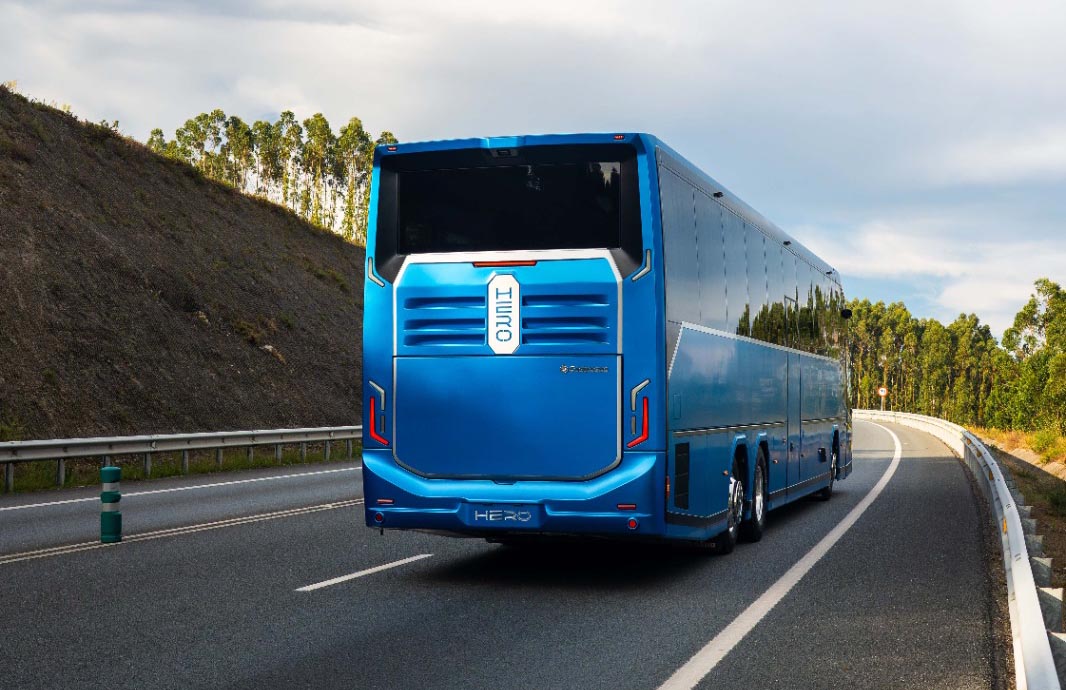
In this regard, Tarrío recalled that 20 years ago, Grupo Castrosua became the first Spanish company to manufacture and supply buses specifically powered by gas (which was a milestone in our country).
In fact, during this time, the company has delivered more than 1,320 CNG buses to different transport operators. Currently, gas vehicles manufactured by our company “account for almost 65% of the Spanish gas bus fleet,” Tarrío highlighted.
The decarbonization of energy
The idea of decarbonization as an alternative to fossil fuels was the focus of the conference’s opening. “Decarbonization is a concept that seeks to avoid the consumption of conventional fuels – derived from oil and coal – and a rational use of natural gas as an ecological alternative,” stated Fernando Blanco, delegate in Santiago of the College of Industrial Engineers of Galicia (ICOIIG).
“These fuels (coal and oil) must be replaced by renewable technologies and energy efficiency in order to achieve a reduction in CO2 emissions and thus meet the objectives in reducing global warming,” he added.
The inaugural event was also attended by Oriol Sarmiento, dean of the ICOIIG; Emérito Freire, technical deputy director of INEGA; and Xan Duro, councilor for Environment and Coexistence of the Santiago City Council. Additionally, the closing session included an intervention by Manuel Varela Rey, director of the Galician Innovation Agency.