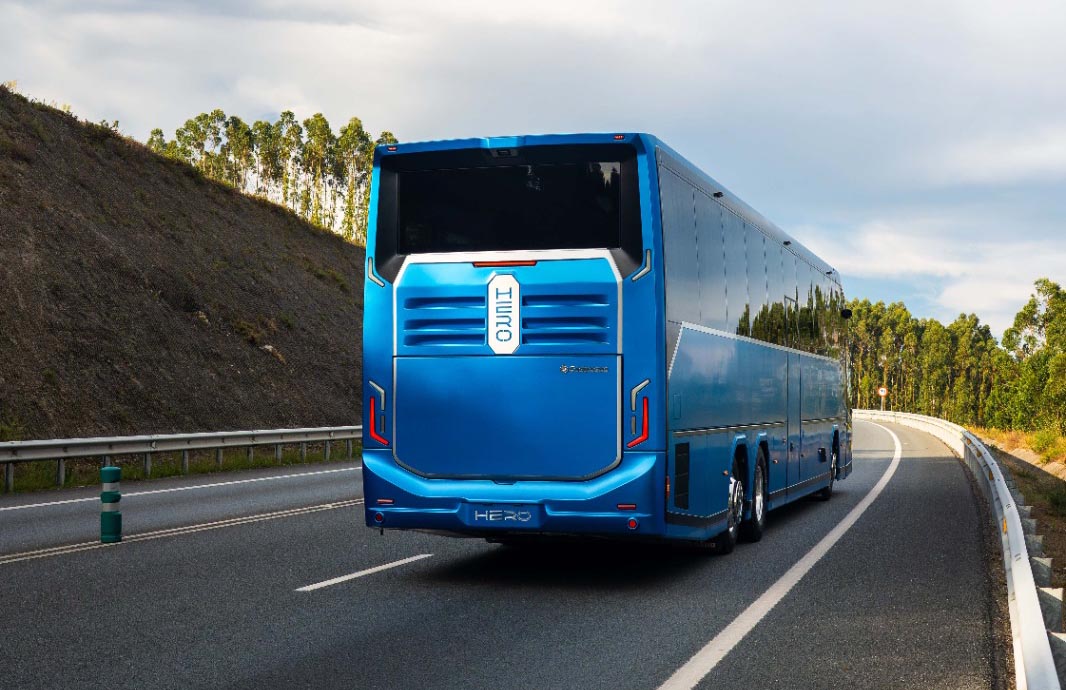
Spanish bus coachbuilders are now a benchmark in Europe and the rest of the world. However, it was not always so. The industry’s origins are very modest; the vast majority of us began our activity at the end of the 19th or beginning of the 20th century, manufacturing wooden coachwork in small workshops. Today, Made in Spain coachwork is a guarantee of experience, personality, and reliability. Would you like to know how we achieved this? Read on! The takeoff of Spanish coachbuilders In the early years of the 20th century, Spain was immersed in the replacement of animal-drawn vehicles with motor vehicles. This period was the starting point for many companies that today are dedicated to bus coachbuilding. Some of these companies had started out as workshops for the construction of wooden carriages or for vehicle repair, but between the 1930s and 1940s, they fully committed to improving vehicles for passenger transport. Thus, they began to manufacture the first coaches and buses in our country, first with wood, and shortly after, sheet metal, on chassis of different origins. In the 1960s, bus coachbuilding businesses were affected by the winds of evolution and modernization that were blowing through Spain. Workshops began to build buses and coaches with resistant materials and innovative designs. Without a doubt, it was time to bet on the bus; due to its effectiveness and lower infrastructure costs, it was destined to replace the tram. We have already told you on this blog that the 60s were a very important era in Castrosua’s history because our coachbuilder partnered with the most relevant vehicle manufacturer of the time: Pegaso. This firm began supplying its first chassis for bus coachbuilding to brands like ours. Thus, Castrosua began to produce the Cometa coachwork, with a Pegaso Comet chassis. The quality of this model made us a benchmark for the entire coachbuilding sector. International projection of Spanish bus coachwork Between the 70s and 80s, urban and interurban buses experienced a period of true splendor in our country. In fact, Spanish bus body manufacturers created the National Association of Bus Body Manufacturers (Ascabus) in 1976 to jointly defend their interests in a sector with growing movement and demand. Thanks to the efforts of these coachbuilding companies, road passenger transport worked better and better. In the 1980s, vehicles had gained many points in comfort, and transport companies were multiplying their routes and services. In the same period, new technologies arrived in Spanish bus and coach coachwork. Citizens in the warmer parts of Spain no longer had excuses not to use these vehicles, which were mostly equipped with a good air conditioning system. Also in the 1980s, coachbuilding companies developed low-floor platforms, which helped the Spanish bus coachbuilding sector continue to stand out and generate interest in other European countries. Little by little, Made in Spain coachwork began to timidly enter foreign markets. Castrosua’s first export occurred at the end of the 80s, with the shipment of two units of the Master 35 model to Portugal. In the 90s, our group received a large order for an international destination: 68 units of Castrosua’s most popular urban bus, the CS-40 City, went to Romania. Since then, both our exports and those of many other Spanish coachbuilders have continued to grow. Differential values of Spanish bus coachwork Why are Spanish bus coachwork so in demand abroad? In this report from El País, which interviews representatives from several Spanish coachbuilders (including Juan Luis Castro, current president of Grupo Castrosua), some reasons are listed: Their seniority, as Spanish coachbuilders have decades of experience. The customization of coachwork, because in Spain, tailor-made models that satisfy each client’s requests are preferred over mass production. The reliability of Spanish labor; the Spanish bus coachbuilding sector provides direct employment to thousands of people. The demands in Spain regarding safety, because our country has very strict regulations on passenger transport that have forced coachbuilding companies to excel, achieving excellence admired throughout Europe. As Javier González Pereira, president of Ascabus, states in this interview from Revista Viajeros, in 2020, the percentage of buses for the export market in the Spanish coachbuilding industry stood at 53.5%. These coachworks were mainly destined for European countries. However, Spanish coachwork is not only present today in more than 30 European countries but also circulates in more than 40 countries around the world. Currently, Grupo Castrosua dedicates about 30% of its production to the international market, without ever losing the seal and personality that defines Spanish coachwork, and without relocating any of its production plants. The sustainability of coachwork is the compass that guides the present and future of the Spanish coachbuilding industry. It is no longer enough to export the best models in terms of safety, comfort, reliability, and customization; today, we want and must work on our contribution to achieving sustainable public transport that makes cities more pleasant spaces with better environmental quality. First, by betting on more ecological alternative fuels such as CNG; then, by focusing on electrification. Because the mobility of the future must be zero-emission. And you, how far do you think Made in Spain coachwork will be able to go? We’ll read your thoughts in the comments. 🙂