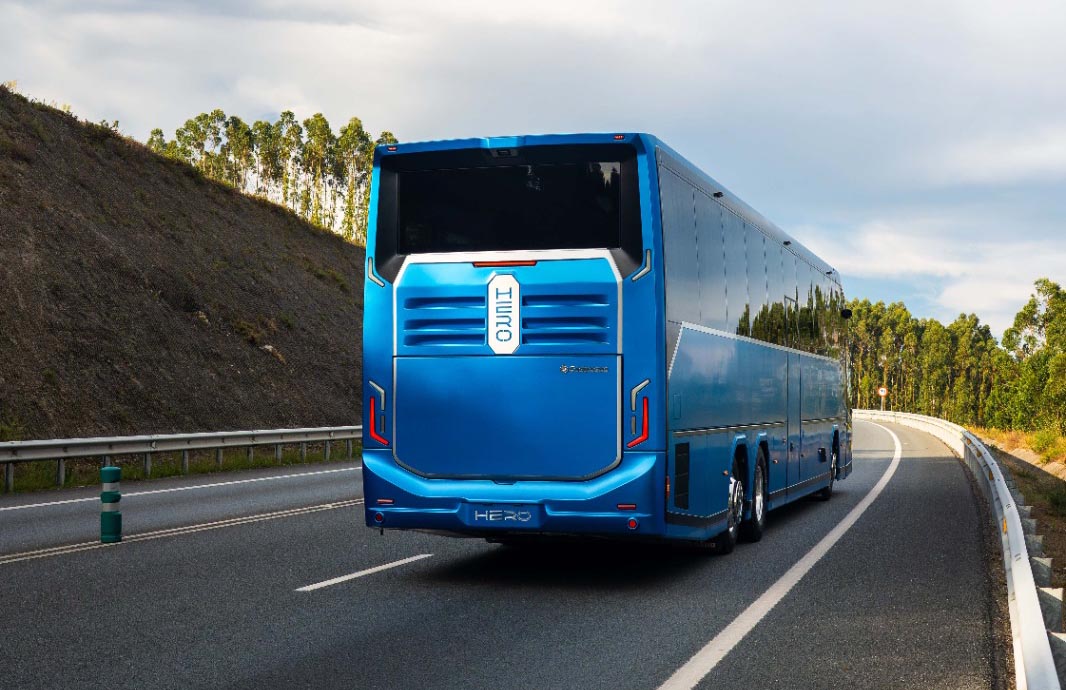

As you know, at the beginning of this year we introduced Nelec, which is not only our first body for an electric chassis but also the first Castrosua vehicle manufactured entirely with 3D technology in all phases of its design.
3D design arrived in Castrosua’s engineering department in 2011, and since then our team has been specializing in this methodology. Thanks to this, we now offer even more flexible, even more customizable bodies, subject to rapid modifications and very agile quality controls.
In this post, we will discuss the application of 3D technology in Castrosua bodies. Keep reading!


The arrival of 3D design in Grupo Castrosua’s engineering department
Since 2011, we have had a team of engineers continuously training in the development of parts and surfaces using 3D design.
Let’s put our readers in context: the Castrosua engineering department is divided into three sections: R&D&I, Technical Office, and Homologations.
Thanks to the use of 3D modeling programs like SolidWorks, and also 2D programs like AutoCAD, Grupo Castrosua engineers can respond quickly and effectively to the numerous needs that arise. They use 3D design to create plans prior to the manufacturing of bodies and to offer clients designs or simulations in the pre-sales processes. The 3D methodology also makes modifications to already manufactured vehicles easier and faster.
In short, the 3D methodology, complemented by the use of other tools, has become a fundamental ally for the entire Castrosua engineering department.
3D Printer
3D design combines perfectly with the use of modern tools such as a 3D printer or an articulated arm 3D scanner that we acquired in 2019.
The 3D printer is used in the R&D&I section, where a team of specialized engineers and professionals work with it, particularly in the development of parts or the improvement of existing parts using the 3D printer. As a curiosity, we can tell you that the first 3D printer we had was built by one of our colleagues – what a brain!

Advantages of the 3D scanner
As we mentioned earlier, a few years ago our group acquired a portable articulated coordinate measuring arm 3D scanner, which reaffirmed our commitment to this methodology, serving as fundamental support for continued innovation and improvement in bus body design.


Thanks to the incorporation of the articulated arm 3D scanner, we can digitize both parts and their surroundings for analysis, modification, and study of potential improvements to be implemented. Specifically, the 3D scanner allows us to:
- Scan old parts and molds (from before the implementation of 3D technology in Castrosua bodies) to digitize them. This is a transition from physical parts to 3D.
Before the implementation of the 3D methodology, parts were made manually. The first one served as a model and was sent to the supplier to make the mold. - The scanner also makes it possible to modify a mold with precision and speed. The mold is scanned, and the modification is made directly in the 3D design program.
- This tool allows us to scan finished parts and compare them with their 3D design. This is used for verification and quality control, an essential step before sending the design to the supplier for the manufacturing of each part.
- Perform structural verifications to ensure that reality faithfully corresponds to the previously created 3D design.
This arm can be used by a team of five engineering professionals (technicians, industrial engineers, and designers) who have received weeks of specific training to operate this scanner, mastering, among other things, the use of Polyworks Inspector and Polyworks Modeler software solutions for handling and controlling data received through a 3D scanner.

Benefits of 3D technology in Castrosua bodies
Although the basic structure and initial construction design of our most recent vehicles had already been done in 3D, it was with our new Nelec vehicle that we felt ready to design the entire body using this technology.
In general terms, and as we have advanced in previous paragraphs, 3D design allows us to anticipate errors that may arise in the manufacturing process and perform simulations of part movements to avoid possible rubbing and interference. It is proven that this work methodology aids precision in vehicle manufacturing.
3D technology also allows us to verify real assemblies on the computer, instead of reviewing part by part of the body using a two-dimensional plan. This technology is also very useful when it comes to repairing some parts.
Another benefit of the 3D methodology is that it facilitates the customization of Castrosua bodies. Thanks to it, we can make any adaptation the client requests more quickly.


For all these advantages, we know that the complete 3D design of Castrosua bodies is the way forward. The success of Nelec, our first electric chassis body designed entirely in 3D, shows us that we are ready to do it. We have a trained and highly motivated team to make the most of what this technology can offer us in the design, production assistance, and improvement of our bus bodies.
We will continue to listen to market needs and take advantage of all the advances resulting from technological development to offer modern vehicles, tailored to each client’s needs.
Thank you for reading!